Benchmarks
These results compare Bindizr with each supported secondary against standalone DNS servers on the same hardware, datasets, and container limits. Figures are the mean of five runs on an 8-core AMD Ryzen 7 9800X3D, with each container capped at 4 CPU / 4 GB. See the benchmark suite for the methodology and commands.
Query throughput
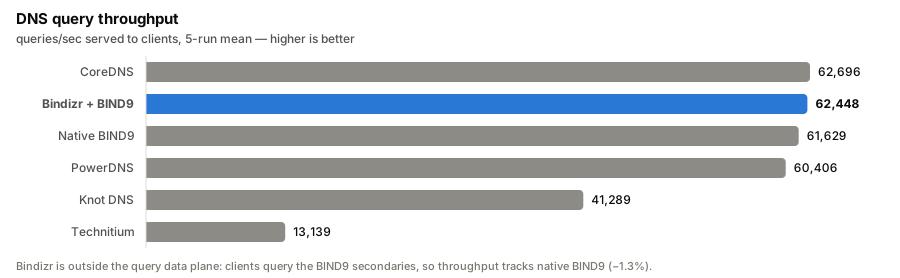
Bindizr never answers a client query — the secondary does — so each pairing
serves what that server serves on its own. Bindizr + BIND9 serves 59,397
QPS against native BIND's 59,904 (−0.8%), Bindizr + PowerDNS 56,949
against PowerDNS's 56,988 (−0.1%), and Bindizr + Knot DNS 40,211 against
Knot's 40,408 (−0.5%), all within run-to-run noise, and Bindizr itself draws
no measurable CPU under that load. NSD has no standalone run in the suite, so
its pairing's 58,114 stands on its own.
Bulk import
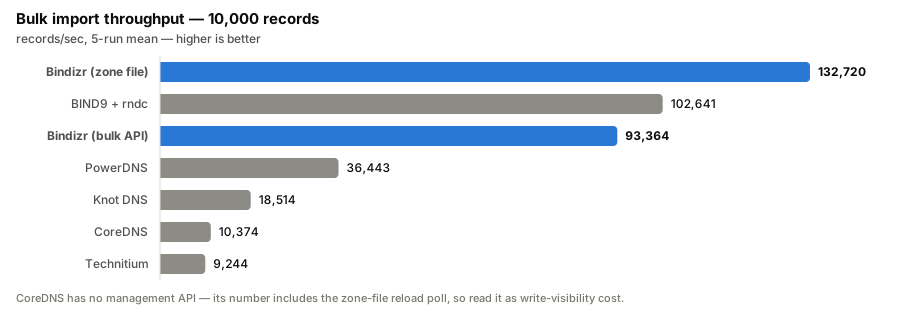
A 10,000-record zone file imports in 88 ms; the same records through the bulk record API take 103 ms. Both paths commit to the database, so the zone survives a restart and transfers to the secondaries immediately. The number is the control plane's: this benchmark runs without NOTIFY, and the four pairings agree within 5%.
Incremental transfers stay incremental
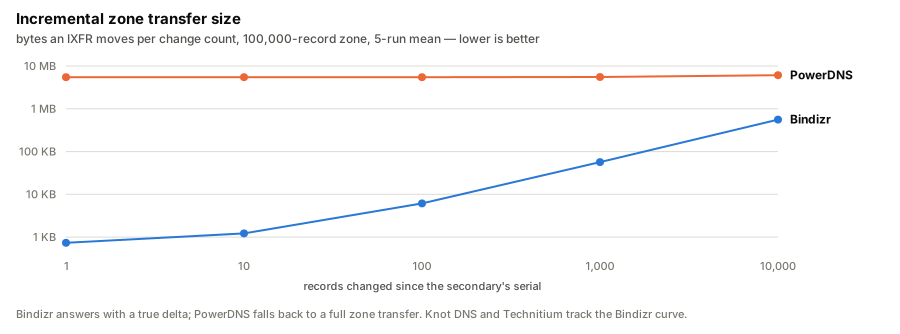
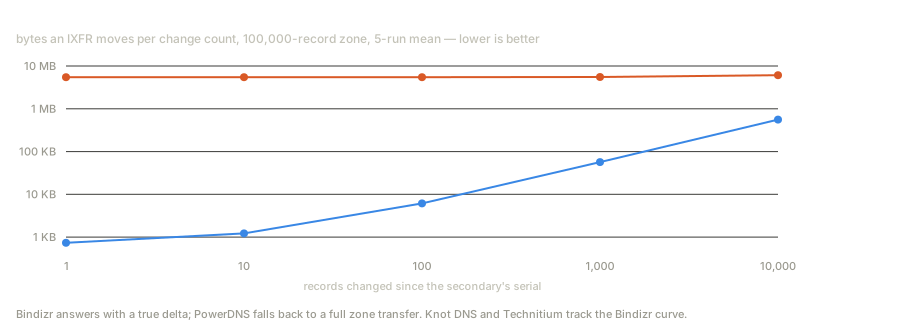
The IXFR journal lets a transfer carry only what changed: 736 B for a single change in a 100,000-record zone, where the full zone is 5.5 MB. BIND, Knot DNS, and NSD secondaries re-serve that delta byte for byte in the tested configurations; PowerDNS answers the same request with the entire zone. Knot DNS and Technitium standalone track the Bindizr curve.
Write path
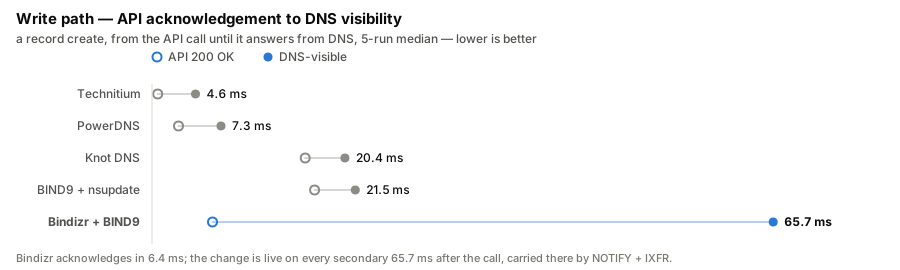
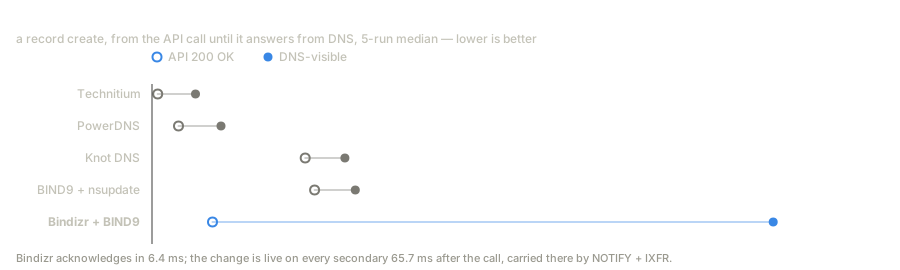
A create is acknowledged in 4.3 ms; when it answers from DNS depends on the secondary: 8 ms after the call with NSD, 65 ms with BIND (p95 75 ms, p99 79 ms, no timeouts), 63 ms with Knot DNS, and 1.0 s with PowerDNS, which applies a NOTIFY on its secondary communicator's next pass. Bindizr commits to the database and propagates by NOTIFY + IXFR, where the integrated servers answer from their own process as soon as they accept the write.
Record CRUD throughput
| System | Create TPS | Update TPS | Delete TPS | Read TPS | Read p95 | Errors |
|---|---|---|---|---|---|---|
| Bindizr + BIND | 397.9 | 362.7 | 345.4 | 13,486.6 | 2.96 ms | 0.00% |
| Bindizr + Knot DNS | 415.6 | 369.6 | 366.7 | 13,603.9 | 2.94 ms | 0.00% |
| Bindizr + NSD | 413.9 | 372.5 | 356.2 | 13,615.2 | 2.94 ms | 0.00% |
| Bindizr + PowerDNS | 410.0 | 374.2 | 364.7 | 13,527.0 | 2.99 ms | 0.00% |
| Technitium DNS | 6,853.6 | 4,783.3 | 5,208.8 | 10,401.9 | 3.59 ms | 0.00% |
| Knot DNS | 716.7 | 1,091.6 | 743.9 | 1,147.2 | 38.38 ms | 0.00% |
| BIND + nsupdate | 383.0 | 880.3 | 373.0 | 1,147.2 | 38.44 ms | 0.00% |
| PowerDNS Authoritative | 83.4 | 67.1 | 82.1 | 2,883.7 | 4.36 ms | 0.00% |
Each write is a durable database commit plus a zone-serial bump, which sets the
per-record write rate — servers that hold the zone in memory do more per second
here. The rate is the control plane's, so the four pairings agree within
run-to-run noise. These runs use SQLite; PostgreSQL puts creates at 417/sec
against SQLite's 383. Read is a management-plane read: an API GET where there
is an API, a dig subprocess otherwise, so those p95s carry process-spawn cost.
Database backends
| Backend | Create TPS | Read TPS | Read p95 | 100k bulk import | Peak memory (stack) |
|---|---|---|---|---|---|
| SQLite | 382.7 | 13,322.5 | 3.00 ms | 0.91 s (110,220/sec) | 190 MB |
| MySQL | 224.5 | 12,357.6 | 4.68 ms | 2.57 s (39,246/sec) | 917 MB |
| PostgreSQL | 416.5 | 11,756.0 | 4.65 ms | 2.63 s (38,312/sec) | 347 MB |
Bulk import stays near-linear from 10k to 100k records on all three backends.
Peak memory is the whole stack (Bindizr + the secondary + the DB server
container) at its highest point, the 100k import; the DB server dominates it —
the MySQL container alone accounts for ~784 MB with its default buffer pool and
performance_schema on, against ~215 MB for PostgreSQL. Bindizr's own process
peaks at 24–28 MB there with an external database (85 MB with SQLite, which
runs in-process) and holds 10–12 MB under the CRUD load (44 MB with SQLite).
These are the BIND pairing's figures; the other three land within run-to-run
noise on every backend.
Software under test
| Software | Version |
|---|---|
| BIND | internetsystemsconsortium/bind9:9.21 |
| Bindizr | built from source |
| CoreDNS | coredns/coredns:1.14.7 |
| Knot DNS | cznic/knot:3.6 |
| MySQL | mysql:26.7 |
| NSD | Alpine 3.24 package, in an image the suite builds |
| PostgreSQL | postgres:18 |
| PowerDNS | powerdns/pdns-auth-49:4.9.17 |
| Technitium | technitium/dns-server:15.5.0 |